
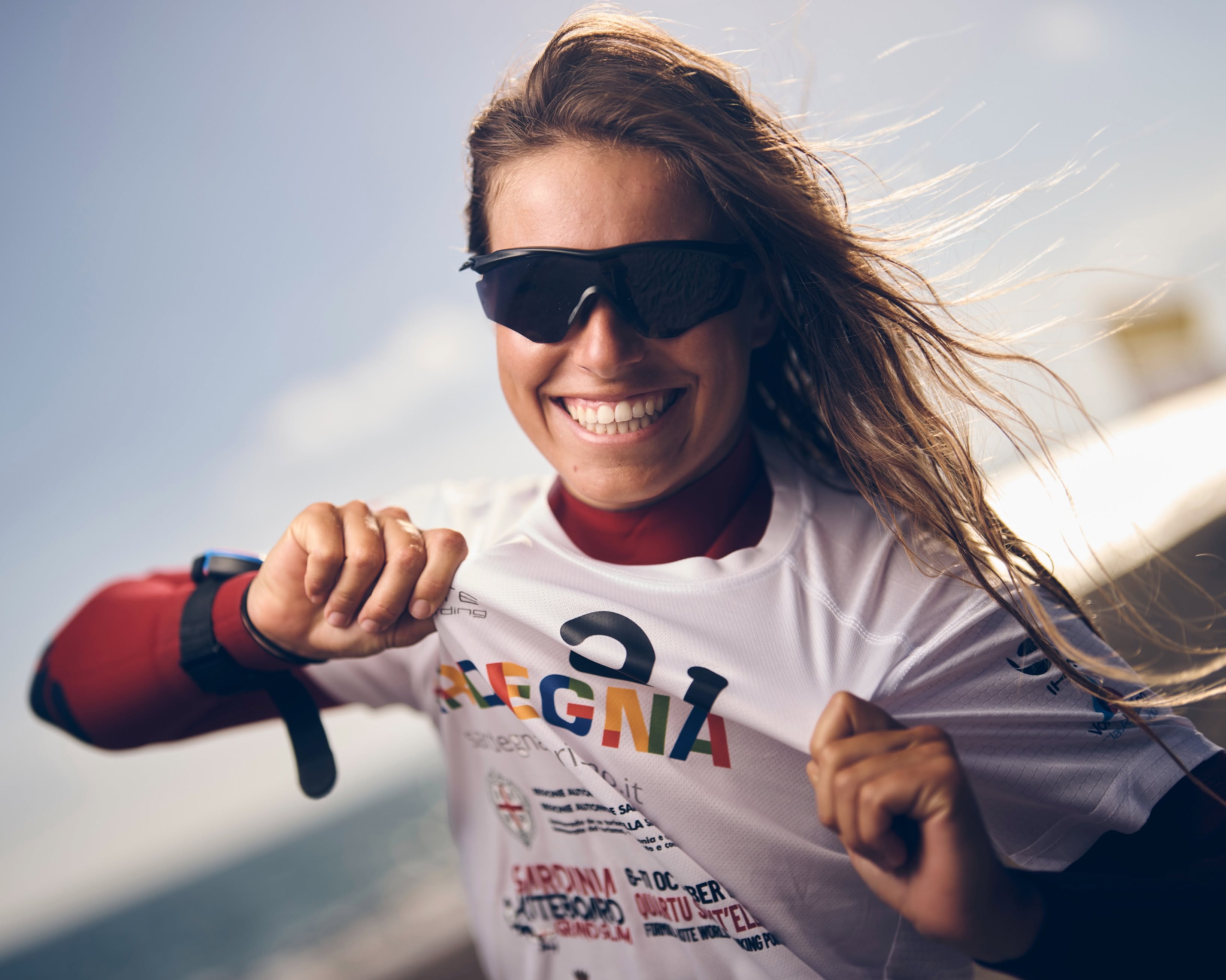
On behalf of global kiteboarding athletes, Paris 2024 silver medallist Lauriane Nolot has issued an open letter to World Sailing and Member National Authorities calling to preserve the discipline's Olympic status.
"Dear World Sailing leaders and Member National Authorities,
We are the athletes who race Formula Kite today and the young athletes working to reach the Olympic start line tomorrow. We ask you to keep the Men’s and Women’s Kite Events in the Olympic programme for Brisbane 2032 and to work with us to make them better.
As Lauriane Nolot, Olympic silver medallist in Formula Kite at Paris 2024, I am writing not only as an athlete who has dedicated years to this Olympic journey, but also on behalf of a generation of athletes, coaches, clubs and national federations who believe in the future of our discipline.
Following a conversation with Tony Estanguet, three-time Olympic champion and President of the Paris 2024 Organising Committee, I was struck by the strength of his reaction to this decision. He considered Formula Kite to be the most spectacular discipline of the Paris 2024 Olympic Games and expressed his complete incomprehension at the prospect of its removal from the Olympic programme for Brisbane 2032. In his view, the direction taken by World Sailing does not align with the expectations of the IOC, particularly when it comes to delivering spectacular, engaging and highly visible sporting events. Our discussion reinforced the importance of Olympic continuity and the need to give Formula Kite the time and support it deserves to reach its full potential.
Formula Kite made its Olympic debut in Paris only two years ago. Already, its future is being questioned before we have even had the opportunity to compete at a second Games. Los Angeles 2028 matters. Paris was our first Olympic appearance, in conditions that challenged the sailing competition as a whole. Let us show what Formula Kite can become at LA28 before deciding that its Olympic path should end.
Eight years is simply too short to build, develop and fairly assess an Olympic discipline.
Athletes have organised their lives around this pathway. Coaches, clubs, families, national federations and Member National Authorities have invested years of work, commitment and substantial resources in it. Young sailors have watched the first Olympic kite athletes and begun to imagine themselves in their place. This investment deserves respect. It should not be dismissed before the discipline has had a fair opportunity to establish itself across multiple Olympic cycles.
Continuity is not merely a matter of fairness to athletes. It is essential to the credibility of the Olympic programme and to the long-term development of our sport. Every new Olympic discipline needs time to build a community, develop its talent pipeline, establish national programmes and create recognisable sporting rivalries. Repeatedly changing direction risks weakening the confidence of athletes, federations and clubs in the Olympic pathway itself.
If we want Olympic disciplines to grow, we must give them time to grow.
Continuity is equally essential to visibility and media exposure. Audiences need time to recognise athletes, follow rivalries, understand the competition and connect with the stories behind the results. That is how Olympic heroes emerge, how fan bases grow and how a discipline becomes commercially and culturally relevant. If we start again after only one Olympic appearance, we lose much more than a racing format: we interrupt the development of an audience and the creation of an Olympic identity.
Formula Kite has many of the qualities the Olympic movement is looking for. It is fast, spectacular, physically demanding and visually striking. Its racing can deliver intense, decisive moments that are compelling for spectators and well suited to modern broadcast and digital platforms. Speed, athletic performance and the spectacular nature of foiling are major assets that we should be promoting much more strongly.
If our objective is to maximise the visibility and media appeal of Olympic sailing, we should invest in making Formula Kite's strengths unmistakable, not abandon a discipline before its full potential has been realised.
We also recognise that Formula Kite must continue to evolve. Equipment accessibility, durability, competition formats, storytelling and broadcast coverage can all be improved. Athletes and national teams must be easier to identify, racing must be easier to understand, and the experience for spectators must be as compelling as the competition itself.
We are ready to work with World Sailing, event organisers, broadcasters, national federations and the wider Olympic movement to deliver these improvements. We want to push for change where it is needed, raise our standards and help our discipline reach its extraordinary potential. Innovation and continuity are not opposites. We can improve the equipment and the event while preserving the Olympic pathway that athletes have already built.
The same questions of accessibility, maturity, visibility and audience development must also be considered when assessing alternative equipment and disciplines, including wingfoiling. Introducing a new discipline does not automatically resolve these challenges. It may simply restart the same process of building athletes, national programmes, audiences and media recognition from the beginning. We should carefully assess whether replacing an established Olympic pathway with a less mature one truly serves the interests of athletes, World Sailing or the Olympic movement.
World Sailing also has an opportunity to strengthen its position by demonstrating a clear and credible approach to Olympic programme decisions. The IOC's evolving approach to reviewing the Olympic programme places importance on the evaluation of disciplines over time and across Games. We believe this principle of meaningful evaluation should be reflected in the way Formula Kite is assessed: on evidence, on its development and on its potential, rather than on the limitations of a single Olympic appearance.
We ask World Sailing to work constructively with the IOC, national federations and athletes to identify the best possible solution for Brisbane 2032. This should include a clear assessment of the sporting and media potential of Formula Kite, the investment already made by national programmes, and the opportunities to improve the event through new equipment and an enhanced competition format.
Our request is clear: retain the Men’s and Women’s Kite Events for Brisbane 2032, with new equipment if necessary, and give Formula Kite the continuity it needs to succeed.
Do not ask athletes, clubs and national federations to commit to an Olympic pathway if that pathway can be withdrawn before it has had a fair chance to mature. Do not underestimate what can be achieved when a discipline is given the stability, visibility and support it needs.
We are not asking for the status quo at any cost. We are asking for the opportunity to improve, innovate and prove what Formula Kite can become. We are ready to take responsibility for that challenge and to work together to make our discipline one of the most spectacular, recognisable and compelling events in Olympic sailing.
Give Formula Kite continuity. Give its athletes a voice. Give Olympic sailing the opportunity to show the world what kite racing can become.
We have only just begun. Please let us keep building.
Yours sincerely,
Lauriane Nolot
Olympic silver medallist Formula Kite, Paris 2024 - 3 times World Champion - 4 times European Champion - French Sailor of the Year 2023
On behalf of the Formula Kite athletes."